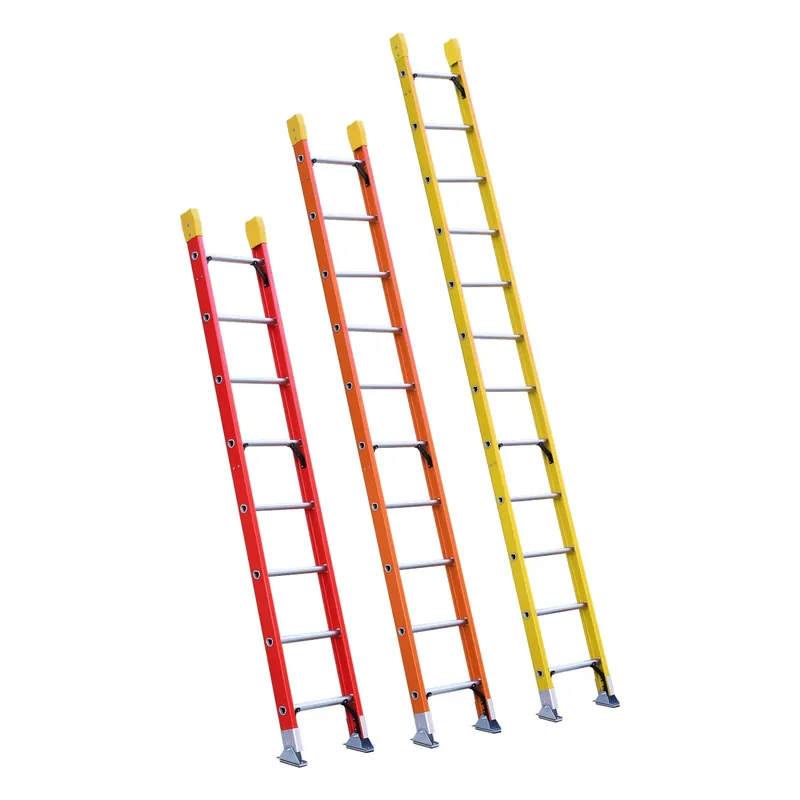
Fiberglass ladder material is a composite: glass fibres are combined with a polymer resin to form a usable component. Understanding that combination helps buyers read a material specification more accurately. The word “fiberglass” identifies a material family; the component drawing, formulation and test documents describe the particular material being supplied.
For importers sourcing fiberglass ladders in bulk, material information is most useful when it is connected to the ladder range and the components being purchased. This guide explains the main terms used in FRP ladder specifications and how to interpret the supporting documentation.
What are fiberglass ladders made of?
In material descriptions, FRP means fibre reinforced polymer. When the reinforcement is glass, the more specific terms GFRP and GRP are also used. “Fiberglass” and “fibreglass” are spelling variants commonly encountered in English material descriptions. The resin forms the surrounding matrix in which the fibres are embedded. Composites UK explains the basic material structure.
The formulation can also include fillers, pigments and other additives. Their presence and purpose depend on the material specification.
| Material element | What it describes | Useful information in a specification |
|---|---|---|
| Glass reinforcement | The fibre component embedded in the resin | Reinforcement type and form, where specified |
| Resin matrix | The polymer surrounding the fibres | Resin system and material grade |
| Fillers and additives | Other ingredients included in the formulation | The purpose and requirements of the specified formulation |
| Finished rail profile | The shape of the manufactured component | Cross-section, dimensions and drawing reference |
These are different pieces of information. Colour alone does not identify the resin or glass content, and a rail dimension does not identify the formulation.
This distinction matters when comparing quotations. Two suppliers can both describe a part as FRP while offering different formulations, reinforcement arrangements or manufacturing processes.
Glass fibre, resin and fiberglass ladder rails
A composite specification needs to describe more than the fibre name. The resin system, reinforcement form and manufacturing process all contribute to the resulting material. Glass reinforcement may be supplied in forms such as rovings, mats or fabrics; resin systems also vary. Composites UK’s materials overview describes these constituent choices.
For buyers comparing fiberglass ladder rails, a useful question is “Which material specification applies to this rail?” A broad description such as “high-quality fiberglass” does not tell you the formulation, dimensions or test conditions.
Ask for a defined specification when a property matters to the order. If a quotation includes a strength or durability claim, the supporting document should identify the tested material and the method used to assess it.
What should an FRP ladder specification include?
An FRP ladder specification should identify the ladder model, relevant components and the material description used for them. For the rails, ask for the profile drawing and dimensions as well as the reinforcement and resin information available for that material. A finished-ladder specification should separately show the configuration, dimensions, product weight and applicable performance documentation.
FRP does not identify a particular resin by itself. Polyester is one resin used in glass-fibre composites, but the abbreviation should not be treated as proof that a particular ladder uses polyester. Composites UK’s materials guide describes several resin systems.
Manufacturing terms also need context. Pultruded fiberglass profiles are formed continuously by drawing resin-impregnated reinforcement through a heated die, as described by Creative Composites Group. SMC is sheet moulding compound, a separate material preparation used in moulding. The process named in a sample document should remain attached to that sample.
For the finished product, use the ladder model specification guide to compare dimensions and configurations consistently.
What does a fiberglass material test report actually show?
Different tests answer different questions. A chemical screening report addresses the substances analysed under the stated methods. A mechanical report addresses the properties tested on the identified specimen. An electrical report must be read for its own test conditions and scope.
RoHS testing concerns specified restricted substances. It is not a measurement of a ladder’s load capacity or electrical insulation. SGS describes the substances covered by its RoHS testing services. When a report uses “ND”, read its definition and detection limit; the abbreviation should not be rewritten as “contains no chemicals” or “zero harmful substances”.
Before using a report in a purchasing decision, read three things together: the sample identity, the results table and the limitations. A pass statement has meaning within those boundaries.
Material documentation for the SSLADDERS fiberglass ladder range
A fiberglass material test report serves as the material reference across the SSLADDERS fiberglass ladder range. This is material-level documentation: the chemical tests describe the substances assessed in the submitted sample. Finished-ladder performance is a separate question that should be reviewed against the selected model and its applicable documents.
Discuss material details for your order
Start with the fiberglass ladder range and identify the model you want to discuss. Send its product link, order quantity, target market and the material or document details you need clarified through the SSLADDERS contact page. Include packaging or OEM requirements when relevant to the order.
If you are choosing between materials, the aluminium versus fiberglass ladder comparison explains how to compare candidate products. The aluminium ladder material guide explains alloy and temper terminology.
Connect the FRP specification to a ladder model
Use a specific product family to turn a material question into a model-level comparison:
- Single-side fiberglass step ladder: review the step range, dimensions and packing for the selected model.
- Two-section fiberglass extension ladder family: compare the 80 mm and 86 mm profile options using the model-specific weight and packing tables.
- Fiberglass multipurpose ladder: check configurations, folded dimensions and packing before shortlisting a model.
Include the exact model code and intended task in the enquiry. For electrical work, request the applicable finished-ladder electrical test documentation; material composition or chemical testing alone does not establish an electrical rating.